Why OilStrikeAI?
It started with a master prompt: research the loudest, most expensive, most underserved pain points in an industry nobody was building AI tools for. Indigenous and mid-size African oil & gas operators kept surfacing — joint venture partners losing real money every month to manual billing reconciliation, and contractual deadlines buried on page 120 of a 150-page agreement that nobody re-reads until it's too late.
That combination — money actually being lost, and a market that's conservative and relationship-driven rather than crowded with competing SaaS tools — is what made it worth building. I wanted to build something that helps real operators in Africa recover real money, not another dashboard nobody opens twice.
Structuring the project
Instead of designing two separate products, I structured it around one core insight: a single contract document (the PSC or JOA) is the source of truth for both problems. Read it once, and it powers two features — JIB Reconciliation (checking billing statements against the contract's cost-sharing terms) and Contract Obligation Tracking (turning buried deadlines into a living daily queue).
Before writing a line of code, I mapped out who actually uses the product day to day — a Director, a Manager, and an Employee each need a different view of the same data — and planned the free-audit -to-paid-subscription funnel first, since a conservative industry needed a zero-risk way to trust a new, unproven vendor.
The features, and how each was built
JIB Reconciliation
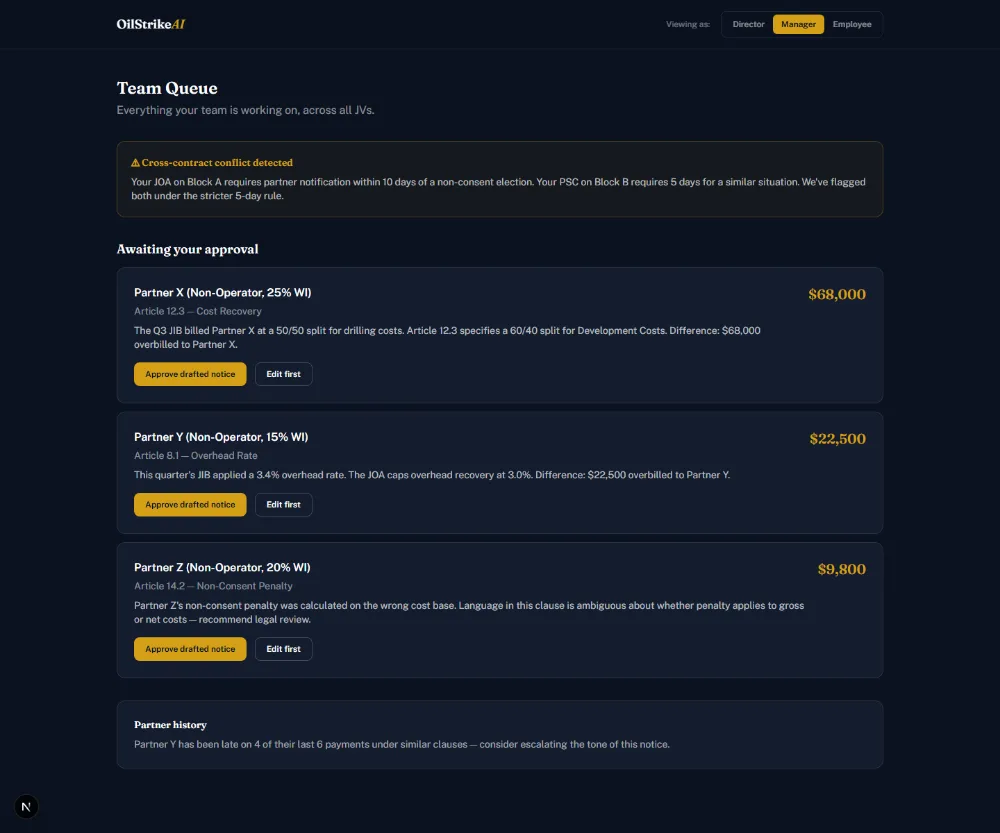
AI reads the contract's cost-sharing clauses, then cross-references every line of the billing statement against them — flagging any mismatch with a citation back to the exact clause.
Obligation Tracker
Every deadline and obligation buried in the contract gets extracted into a daily task queue instead of sitting in a document nobody re-opens.
Role-based dashboards
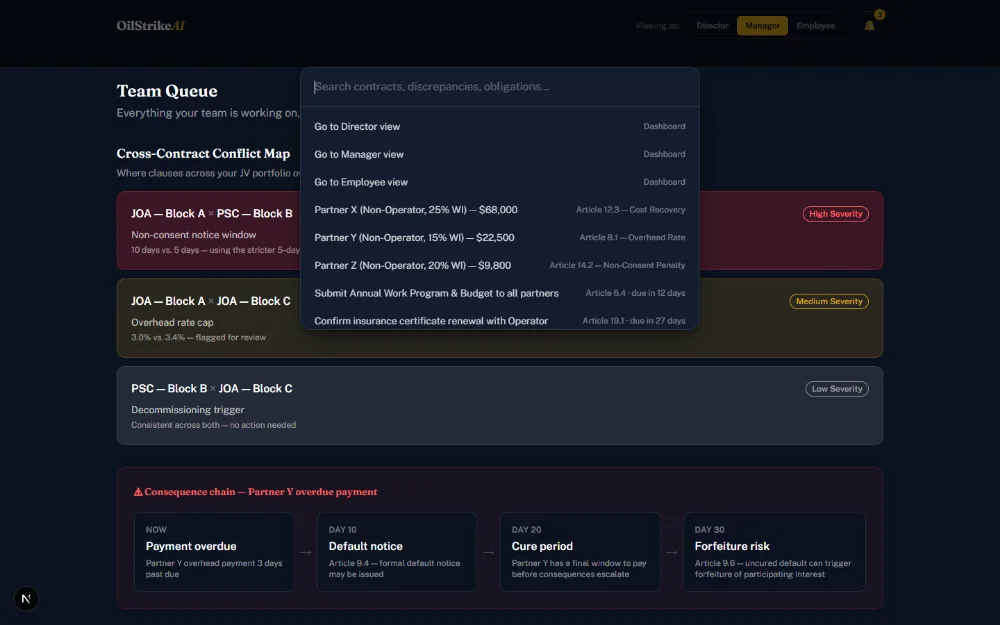
Director, Manager, and Employee each get a view scoped to what they actually need to act on — built as one shared data layer with three presentation layers on top.
Command bar & reports
A quick-query command bar for ad-hoc questions, plus automated PDF audit reports generated straight from the underlying findings.
Design decisions
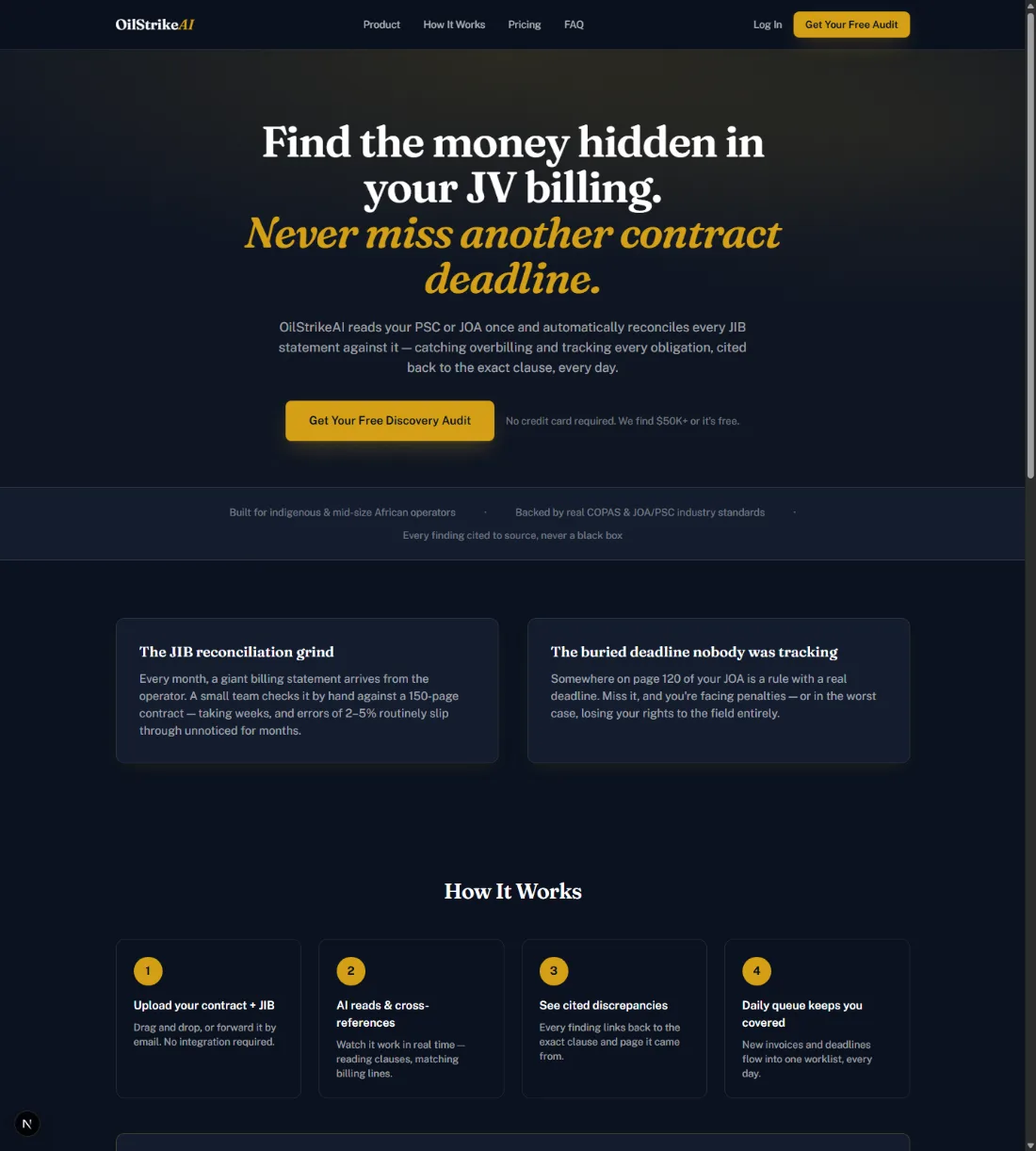
The dark navy-and-gold palette was a deliberate choice — this product is for directors and executives making high-stakes calls, and it needed to feel authoritative and premium, not like a consumer app.
The weekly briefing is written as a WhatsApp-style digest on purpose, because that's genuinely how executives in this market communicate day to day. And every single finding carries a citation back to source — "never a black box" isn't a tagline, it's a UI rule baked into every screen, because trust is the entire product in an industry this conservative.
Tools & tech stack
Built on Next.js and Supabase, with AI-driven document extraction handling the actual contract and billing-statement reading, custom PDF report generation for the audit deliverables, and Vercel for deployment.
I built it working directly with Claude Code as a pair-programming partner — planning the architecture, writing and reviewing the extraction logic, and iterating on the dashboard UI, which let me move at a pace that wouldn't have been possible solo.
Thinking through the business model
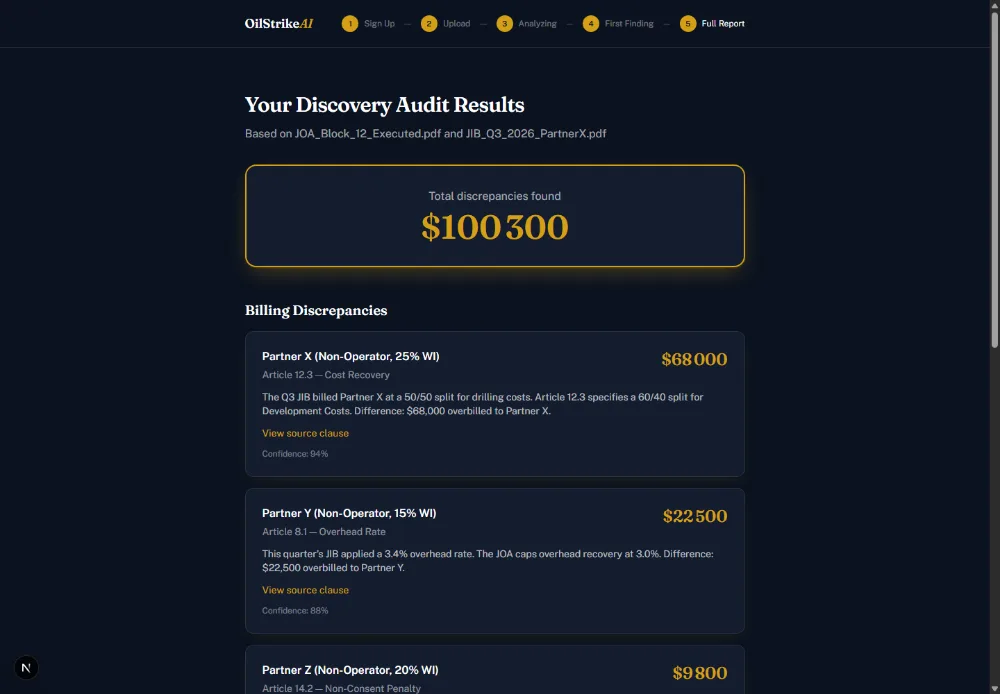
Three revenue lines, deliberately sequenced: a free, contingency-based Discovery Audit as the trust-building entry point (zero risk to the buyer); a tiered monthly subscription priced by JV count and JIB volume rather than headcount, since this business is asset-heavy, not people-heavy; and consulting, offered only after the product has already proven itself with that client.
The free audit isn't a teaser — it's the full, real report, because a genuinely complete result is what makes someone say "this actually works" instead of feeling like a trick.
Where it stands now
OilStrikeAI is in the final stretch of the build — the core extraction, reconciliation, dashboards, and reporting are in place, and the remaining work is polish and validation before the first design partner comes on to test it against real PSC/JOA and JIB documents.